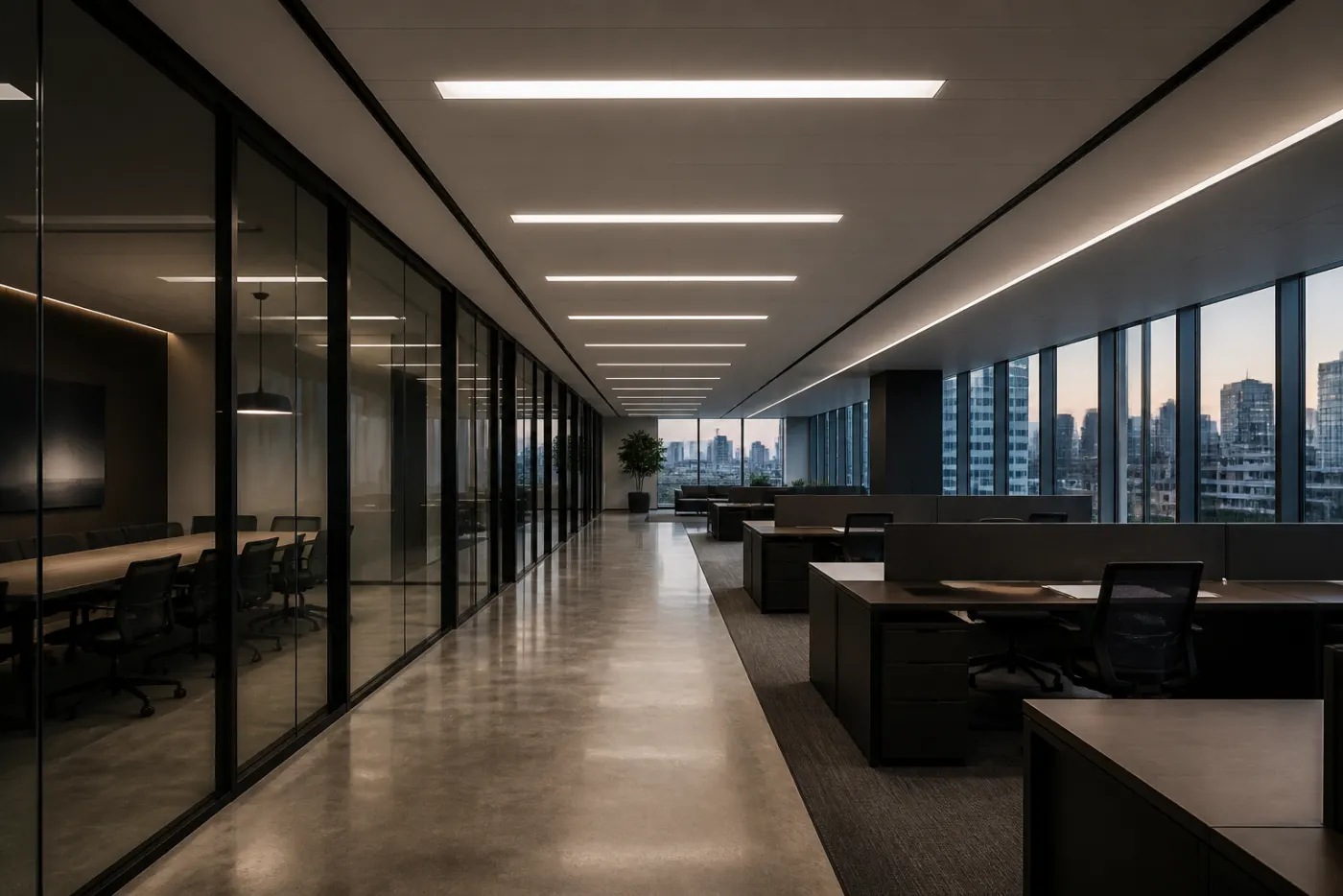
How long do LED lights last in a commercial building? Manufacturers print figures like 50,000 hours on the datasheet, but that number gets used loosely. In a Sydney office or warehouse running 12 to 16 hours a day, the real answer depends on temperature, driver quality, the way the system is dimmed, and what "lifespan" is actually being measured.
Quality commercial LED fittings are typically rated for 50,000 to 100,000 hours of useful life, which works out to roughly 10 to 25 years at commercial run hours. That is the headline. The detail behind it matters for anyone specifying lighting that has to perform for the life of a lease, a refurbishment cycle, or a building's depreciation schedule.
How LED lifespan is measured
LEDs do not fail like fluorescent or halogen lamps. They do not burn out and stop working. They dim gradually, a process called lumen depreciation. To make lifespan claims comparable, the industry uses L-ratings.
An L70 rating is the number of operating hours before light output drops to 70 percent of the original. L80 is the equivalent at 80 percent output. L70 is the most commonly published figure on Australian commercial LED specifications. If a fitting is rated "L70 at 50,000 hours", it means that at 50,000 hours the fitting is still producing 70 percent of its day-one light.
How long do LED light bulbs last in practice depends on which L rating the manufacturer publishes and at what ambient temperature. Datasheets that quote L70 at 25°C will perform differently in a 40°C warehouse roof space than the catalogue number suggests.
What 50,000 hours means in a commercial building
Run hours decide how that number translates to calendar years.
- An office running 10 hours a day, five days a week: roughly 2,600 hours a year. 50,000 hours is about 19 years.
- A retail or hospitality site running 14 hours a day, seven days a week: roughly 5,100 hours a year. 50,000 hours is about 9 to 10 years.
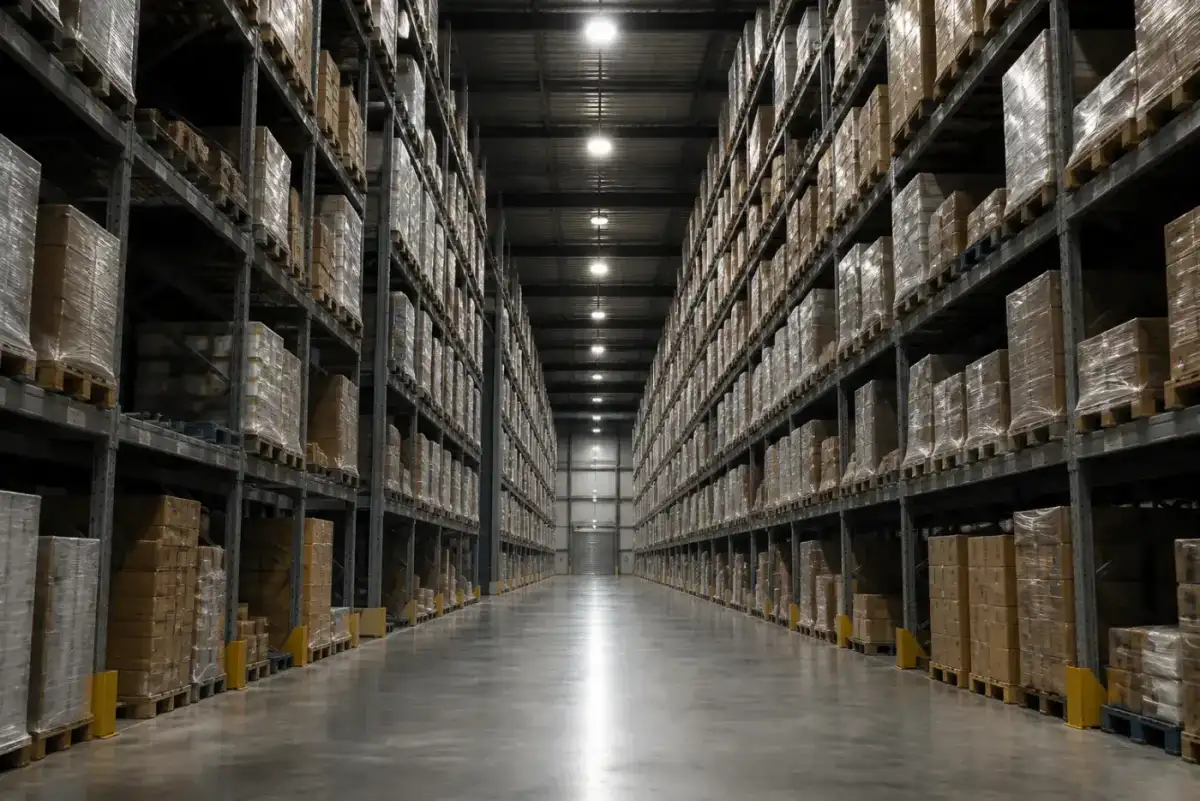
- A 24/7 warehouse, data centre, or hospital: 8,760 hours a year. 50,000 hours is under 6 years.
How long will LED lights last on a specific site is a calendar question, not just a fittings question. Two sites buying the same product will reach end of rated life on different timelines, and the spec needs to be built around the run pattern.
The factors that determine how long LEDs really last
Three variables do most of the work.
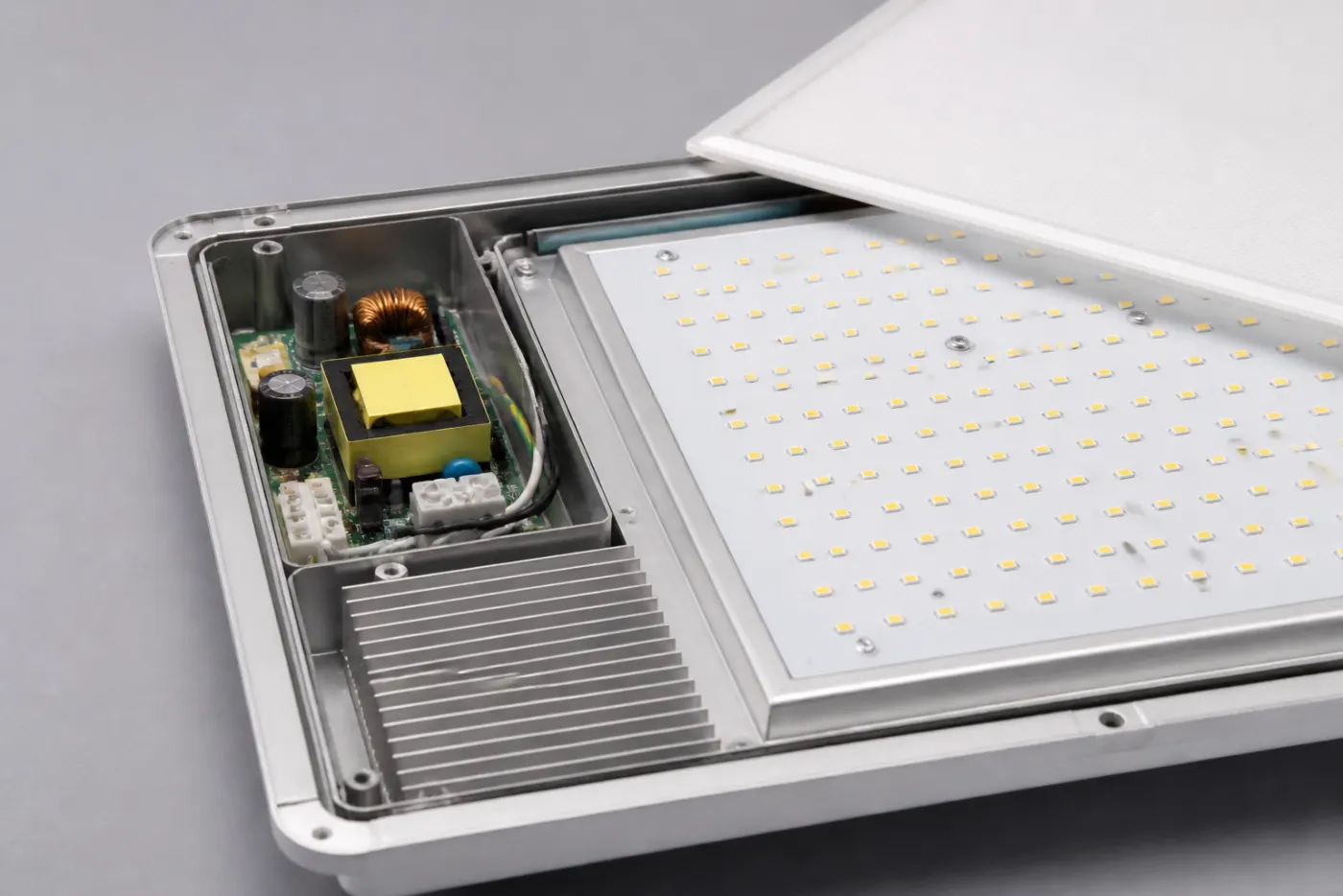
Heat is the single biggest factor. Every 10°C increase in the LED's junction temperature roughly halves its effective lifespan. A fitting with a poor heatsink, mounted in a hot ceiling void or above a server rack, will not get anywhere near its datasheet hours. The body of the fitting and its thermal design matter more than the LED chip itself.
Driver quality is the second. The LED chip is usually the longest-lived component in the fitting. The driver, the electronics that convert mains AC into the steady DC the LED needs, often fails first. Cheap drivers can fail in two to three years. Quality commercial drivers are typically rated for 50,000 hours or more, matching the LED.
Power supply and dimming control affect it too. Voltage spikes, harmonic distortion on the mains supply, or incompatible dimmers will all shorten the life of an LED fitting. A clean supply and a properly matched control system extend lifespan and avoid the flicker problems that are usually the first sign something is wrong.
LED lifespan versus fluorescent, halogen and metal halide
How long can LED lights last compared with the products they typically replace?
- Halogen and incandescent: 1,000 to 2,000 hours. LEDs are 25 to 50 times longer-lived.
- Compact fluorescent (CFL): 8,000 to 10,000 hours. LEDs roughly 5 to 10 times longer.
- Linear fluorescent (T8 and T5 tubes): 15,000 to 30,000 hours. LEDs typically 2 to 3 times longer.
- Metal halide high bay: 10,000 to 20,000 hours, with heavy lumen depreciation well before end of life. LEDs 3 to 5 times longer, and holding output far better through the life of the fitting.
The lifespan jump is one of two reasons the fluorescent to LED retrofit story has accelerated across Sydney commercial buildings. Energy savings get the headline. Avoided maintenance call-outs are the quieter saving, especially in high-bay warehouses, multi-storey car parks, and any site where a lamp change needs an EWP or after-hours access.
Why some LED installations fail early
When LED lighting fails in two to four years rather than ten, the cause is almost always one of:
- Cheap drivers paired with quality LED chips, producing premature driver failure
- Fittings installed in hotter environments than they were rated for
- Power supply problems on the building side, including unbalanced phases and voltage transients
- Dimmer or control gear that is not compatible with the LED driver
- Incorrect specification, where the product was never suited to the application
The first two account for the majority of premature failures picked up during audits in Sydney commercial buildings. Both can be designed out at the specification stage rather than discovered three years in.
How to maximise commercial LED lifespan
The decisions that protect lifespan are mostly made before the fittings are ordered.
- Specify thermal performance, not just lumens. Ask for the L70 rating at the actual ambient temperature the fitting will run at, not at 25°C laboratory conditions.
- Specify the driver as carefully as the LED. A 50,000 hour LED behind a 20,000 hour driver gives a 20,000 hour fitting.
- Use dimming or daylight harvesting where it suits. Running an LED at 80 percent output extends its effective life and reduces heat at the junction. DALI lighting controls make this practical in office, retail and warehouse environments.
- Choose fittings that match the space. A surface-mounted batten in a warehouse roof needs different thermal performance to a recessed downlight in a meeting room ceiling.
- Commission the install properly. Confirm lux levels, dimming behaviour, and emergency lighting integration before the project is signed off.
The financial case, covered in our LED lighting energy savings guide, assumes the fittings actually reach their rated life. Premature failure undermines the cost case as much as it does the lighting quality.
Warranty, L-rating and reading the spec sheet
Lifespan claims and warranty are different things. A 50,000 hour L70 rating describes how the fitting performs over time. The warranty is the manufacturer's commercial commitment if it fails before that. The two should be read together, not confused with each other.
When reviewing a commercial LED spec sheet, look for:
- Rated life with L-rating (e.g. L70 at 50,000 hours, ideally L80 if you need consistent light levels)
- Driver life rating, stated separately from the LED chip
- Ambient temperature rating (Ta), often Ta25 or Ta40
- CRI and CCT so light quality is preserved through the life of the fitting
- AS/NZS compliance, including AS/NZS 60598 for luminaire safety and AS/NZS 1680 for interior lighting performance
The Lighting Council Australia maintains industry guidance on responsible LED specification, and the Australian Government's Energy Rating site lists the regulatory framework for LED products sold here.
Lifespan on real commercial projects
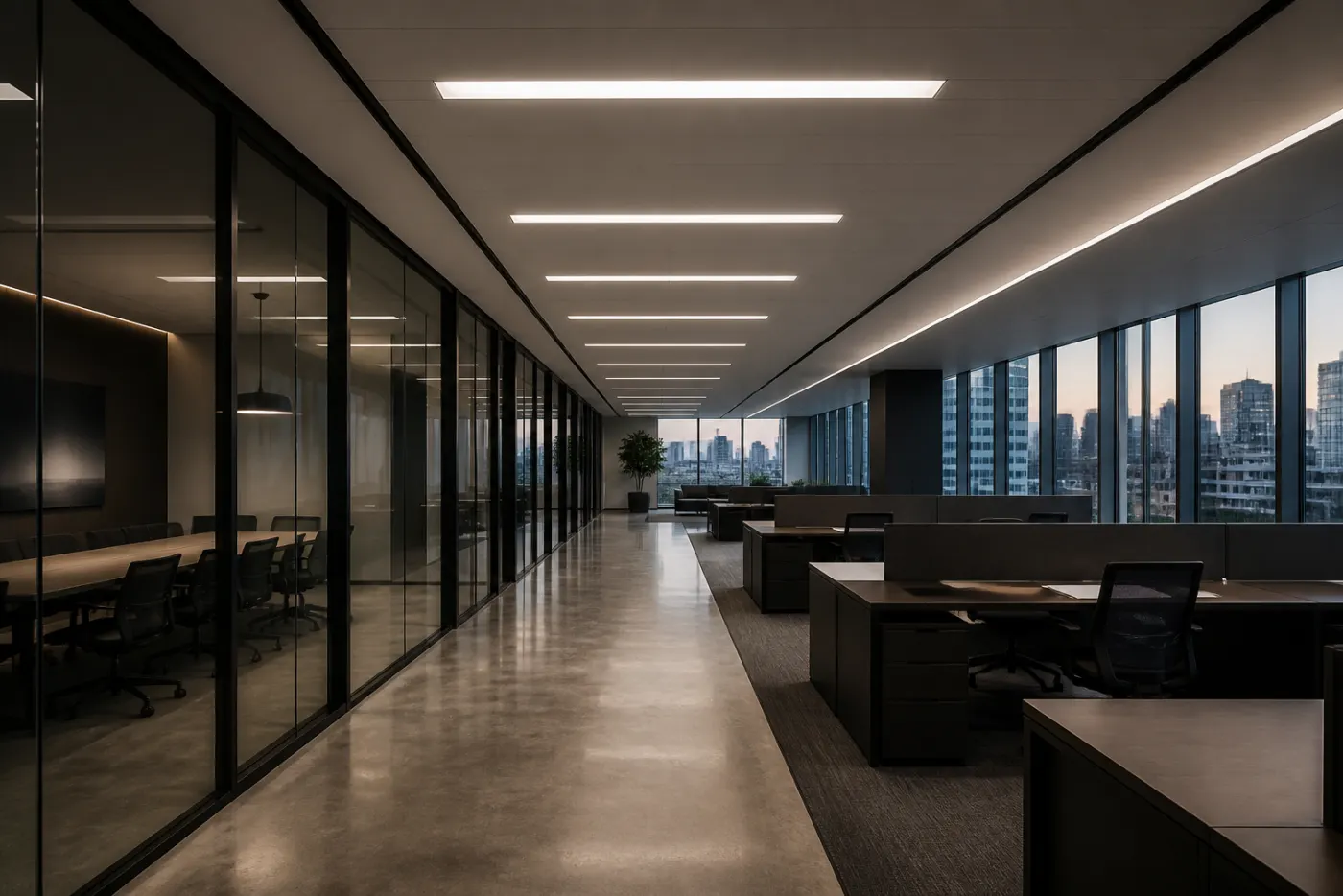
At Chifley Tower the office floors were retrofitted with custom LED panels in place of the original fluorescent fittings, with DALI controls integrated across the install. Quality commercial LED panels of that type are typically specified at L70 of 50,000 hours, which at office run hours puts the fittings well past the next major fit-out cycle. The Chifley Tower case study walks through how that project was scoped and delivered.
The shorter version: well-specified commercial LED lighting outlasts the fit-out it sits inside. The cost case is built on that. Where it falls apart, it almost always falls apart on driver quality, thermal design, or specification mistakes that are catchable at audit.
Get in touch to discuss a commercial LED project. We will start with a site audit and a written specification that covers L-rating, driver life, and the thermal conditions the fittings will actually run in.